 Dear parents and carers,
It has been a busy week in school. The Year 1 and Year 2 classes have been building into this term’s timetable and curriculum whilst, at the same time, continuing to get to know everyone in class. Reception have completed their first week of full-days. They are still finding their feet at times but are settling well and understanding the routines of the day. They have been sharing stories, singing nursery rhymes and carrying out lots of activities to help them continue to build that class bond. I’m sure they will be tired tonight!
Excitingly, ourselves and Pilton Bluecoat applied and were chosen, in July, as two of thirteen schools in Devon to be Relational Practice Pathfinder Schools. This week we had our first meeting with the Devon County Council project leads. A Relational approach to behaviour is something we, as a school and a Trust, have been working on for the past four to five years. It is built on the belief and the research evidence that children thrive when they feel safe, understood and valued and when relationships form the foundation of every aspect of school life. We are committed to creating a learning community where everyone belongs, everyone is known, and every child has the opportunity to flourish academically, socially and emotionally.
Our Relational Approach to Behaviour Policy has been updated recently and is available on the school website. Some of the key aims are:
- To support children to understand and learn how to regulate their emotions. We use the zones of regulation to support this.
- Establish clear, fair and understood boundaries
- Provide systems for relational repair and restoration when things go wrong
- Strengthen communication and partnership with parents and carers – children are much more successful when school and home work together
- Reduce the need for punitive or exclusionary practices
A myth about Relational Approaches to behaviour often is that there are no consequences when behaviour doesn’t meet expectations. This is not the case. However, rather than punitive consequences, we work on natural consequences and restoration. For example:
- If a child hasn’t kept others safe on the playground, they may need some time away from the playground with a restorative conversation about keeping others safe followed by the chance to apologise and restore relationships.
- If a child has chosen to deliberately waste time within a lesson and has not completed their learning. Then a natural consequence is to spend a few minutes of their playtime completing the work and again having a restorative conversation to make better choices.
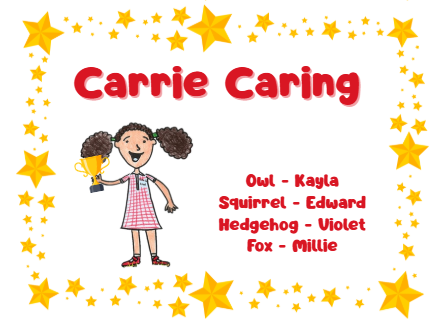
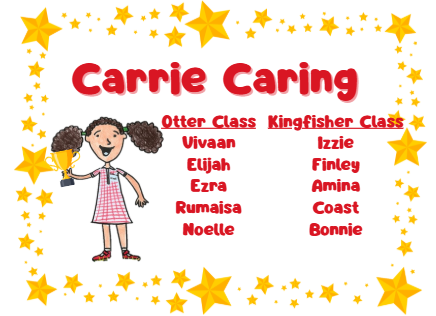
Our focus learning hero this week has been Carrie Caring. We’ve been promoting looking after others, looking after our school and thinking about how others are feeling. We’ve reminded the children that we don’t have rough play.
Finally this week, just a reminder that we are a Nut Free School. We have children and staff with significant nut allergies. Please be vigilant for products such as cereal bars and chocolate spreads containing nuts.
Have a lovely weekend.
Best wishes,
John Mortimer
Head of School